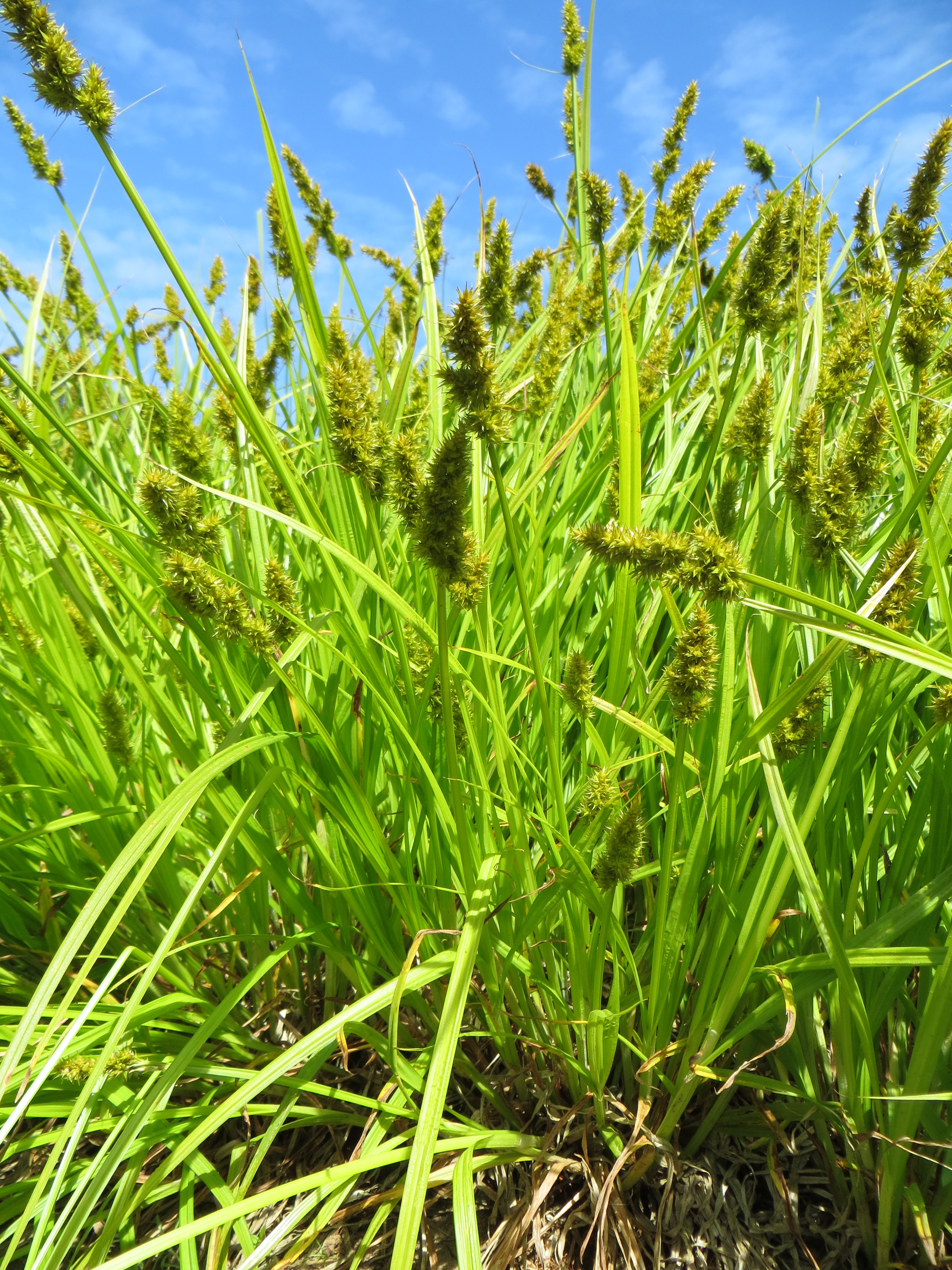
Northwest native rhizomatous sedge found on sandy seashores. Flowering heads large, 2-3″ on 6-18″ plant. Carex macrocephala Large Headed Sedge
Densely tufted sedge, with attractive flowering spikes, found in dry to moist habitats of the northwest. Excellent ornamental potential. Carex mertensii Merten's Sedge
West Coast native evergreen sedge for moist to wet sites, rhizomatous and vigorous. Attractive sedge in mass, for shade or sun. In shallow water, creates important egg-laying habitat for amphibians. Containerize for ornamental ponds. Carex obnupta Slough Sedge
Common western US native tufted sedge found in the transition zone from wet to dryish open habitats. Great potential rain garden species. Carex pachystachya Chamisso Sedge
West Coast native rhizomatous sedge found along sandy shorelines. Important species for helping stabilize sandy beaches. Has been used as a substitute for lawn grass in well-drained soils. Carex pansa Sand Dune Sedge
North American native sedge forming solid clumps in moist areas. Attractive light green foliage, flowering culms to 4′. Carex stipata Sawbeak Sedge
Western native tufted sedge with slowly-expanding rhizomes. Found in sunny dry meadows and open forests. Carex tumulicola Foothill Sedge
Native rhizomatous, mat-forming sedge of freshwater wetlands or streambanks. Carex vesicaria Inflated Sedge
Native clumping sedge found in moist meadows, marshes and ditches. Great potential rain garden plant. More common east of the Cascades but ours is from a Whatcom County population. Carex vulpinoidea Fox Sedge
Native groundcover which carpets the ground with white flowers in the spring. Drought tolerant, prefers sun or partial shade. Cerastium arvense Field Chickweed
Widespread North American native perennial to 4-6’ tall, with showy pink flowers, good for honey production and butterflies. Strong rhizomes provide excellent erosion control. Common in dry to moist disturbed areas. Chamerion angustifolium Common Fireweed
Small tree to 40 feet tall with rich green leaves, gray-green beneath. White flowers in April or May, often sporadic blooming in summer. Red to orange fruit in fall. Difficult to establish due to disease susceptibility. Cornus nuttallii Pacific Dogwood
Thicket-forming native shrub with dark-red stems, white flower clusters, white berries. Great wildlife and erosion-control plant. Grows to 10-14 feet tall, often used as an ornamental. Our western WA strain is disease resistant here. Cornus sericea Redtwig Dogwood, Red Osier Dogwood
Small tree or multi-stemmed shrub to 25 feet tall in sun or shade. Excellent wildlife plant; nuts are food for birds and squirrels. Coppices quickly after disturbance. Corylus cornuta v. californica Beaked Hazelnut, Filbert
Shrubby tree to 30 feet tall with large thorns, white flowers in early spring and black fruit. Excellent wildlife plant; flowers attract butterflies and fruit attracts birds. Commonly found along streams. Crataegus douglasii Douglas Hawthorn
Western native bunchgrass found in moist to dry, sunny meadows. Danthonia californica California Oatgrass
Widespread native bunchgrass found in moist to dry, sunny meadows. Danthonia spicata Poverty Oatgrass